> ## Documentation Index
> Fetch the complete documentation index at: https://docs.notifuse.com/llms.txt
> Use this file to discover all available pages before exploring further.
# Attribution
> Classify traffic into channels with rules you control, and rewrite history when you change them.
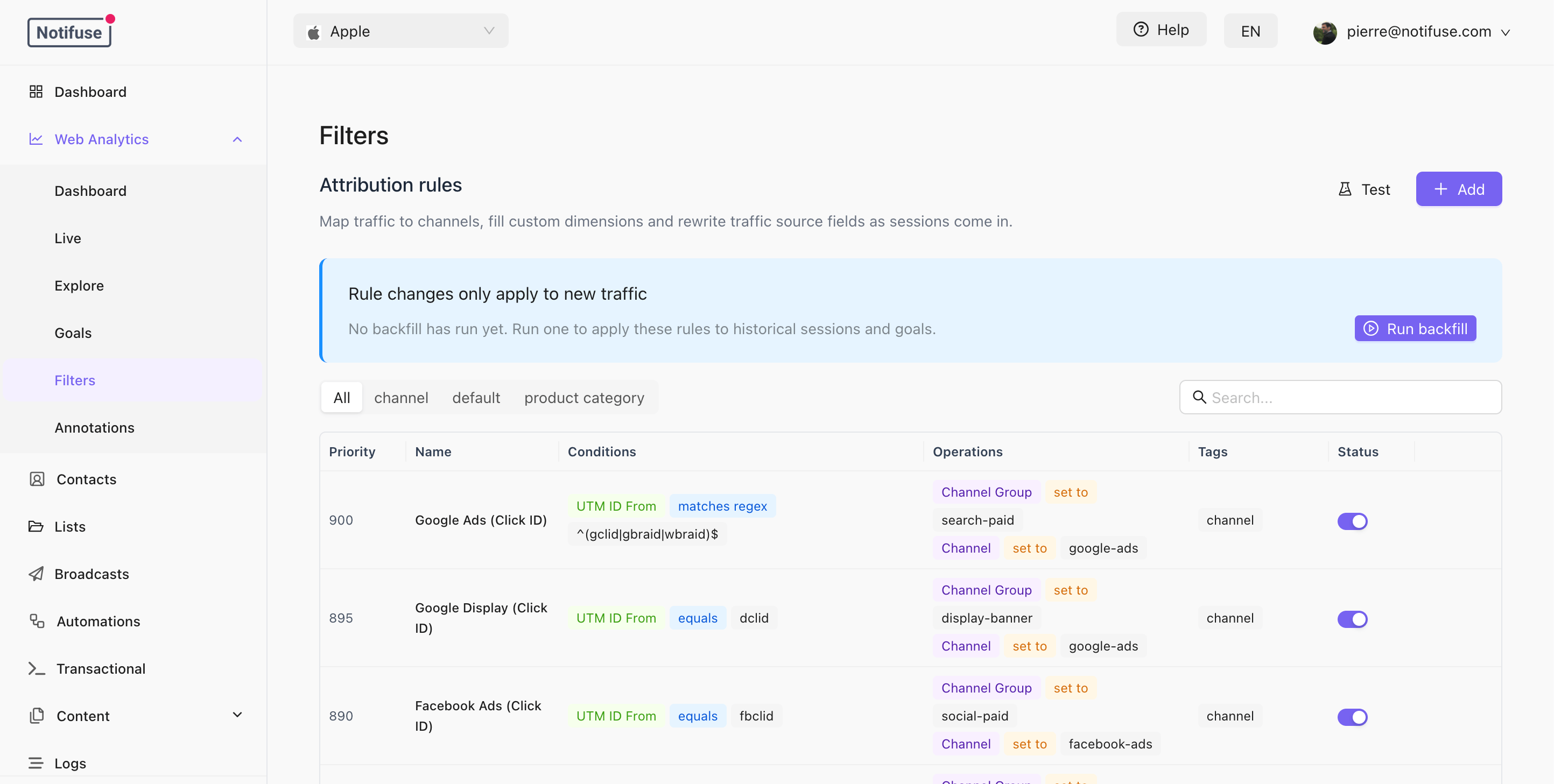 Every visit arrives with raw signals: a referrer, some UTM parameters, maybe an ad click ID. Attribution rules turn those into a **Channel** and a **Channel Group** you can report on.
## Default Rules
A new workspace starts with 39 rules covering paid search, paid social, paid video, display, organic search, organic social, email and direct. They are ordinary rules: you can edit or delete any of them.
| Priority | Family |
| -------- | ---------------------------------------------------------------------- |
| 900–831 | Paid, identified by ad click ID |
| 830–770 | Paid, identified by a known UTM source together with a paid UTM medium |
| 760 | Paid display, identified by referrer |
| 750 | Direct, declared by `utm_source=direct` and `utm_medium=none` |
| 745 | Email |
| 740 | Direct traffic — no referrer *and* no campaign parameters |
| 705–650 | Organic search |
| 600–510 | Organic social |
| 10 | Fallback — `not-mapped` |
Email sits above Direct Traffic deliberately. Many mail clients strip the referrer, so a click from an email otherwise looks like someone typing your address — which is why your broadcasts should carry UTM parameters.
There is no seeded rule for **referral** traffic. A plain link click from another site matches nothing and lands in `not-mapped`, by design: it surfaces in the Filters tab so you can classify those referrers once, rather than being quietly bucketed. Add your own rule on Referrer Domain when you want a referral channel.
For the same reason, the paid UTM rules require a *known* source as well as a paid medium — `utm_medium=cpc` from a network Notifuse does not ship a rule for falls through to `not-mapped` rather than being called paid.
## How Rules Are Applied
Rules run by priority, highest first, and **every matching rule contributes** — evaluation does not stop at the first match.
Precedence is per target rather than per rule:
* For each target, the highest-priority rule that writes it wins.
* A lower-priority rule can still write a target no higher-priority rule claimed. A rule that only sets `custom_3` therefore applies even when a higher-priority rule already set the channel.
* Two matching rules at the *same* priority both run, and the later one overwrites — a tie goes to the last rule, not the first.
* `set as default` never claims a target, so a lower-priority `set` still overrides a default written earlier. That is how the priority-10 fallback works.
## Writing a Rule
A rule is a set of conditions and the values to write when they all match. All conditions of a rule must match for it to apply.
Every visit arrives with raw signals: a referrer, some UTM parameters, maybe an ad click ID. Attribution rules turn those into a **Channel** and a **Channel Group** you can report on.
## Default Rules
A new workspace starts with 39 rules covering paid search, paid social, paid video, display, organic search, organic social, email and direct. They are ordinary rules: you can edit or delete any of them.
| Priority | Family |
| -------- | ---------------------------------------------------------------------- |
| 900–831 | Paid, identified by ad click ID |
| 830–770 | Paid, identified by a known UTM source together with a paid UTM medium |
| 760 | Paid display, identified by referrer |
| 750 | Direct, declared by `utm_source=direct` and `utm_medium=none` |
| 745 | Email |
| 740 | Direct traffic — no referrer *and* no campaign parameters |
| 705–650 | Organic search |
| 600–510 | Organic social |
| 10 | Fallback — `not-mapped` |
Email sits above Direct Traffic deliberately. Many mail clients strip the referrer, so a click from an email otherwise looks like someone typing your address — which is why your broadcasts should carry UTM parameters.
There is no seeded rule for **referral** traffic. A plain link click from another site matches nothing and lands in `not-mapped`, by design: it surfaces in the Filters tab so you can classify those referrers once, rather than being quietly bucketed. Add your own rule on Referrer Domain when you want a referral channel.
For the same reason, the paid UTM rules require a *known* source as well as a paid medium — `utm_medium=cpc` from a network Notifuse does not ship a rule for falls through to `not-mapped` rather than being called paid.
## How Rules Are Applied
Rules run by priority, highest first, and **every matching rule contributes** — evaluation does not stop at the first match.
Precedence is per target rather than per rule:
* For each target, the highest-priority rule that writes it wins.
* A lower-priority rule can still write a target no higher-priority rule claimed. A rule that only sets `custom_3` therefore applies even when a higher-priority rule already set the channel.
* Two matching rules at the *same* priority both run, and the later one overwrites — a tie goes to the last rule, not the first.
* `set as default` never claims a target, so a lower-priority `set` still overrides a default written earlier. That is how the priority-10 fallback works.
## Writing a Rule
A rule is a set of conditions and the values to write when they all match. All conditions of a rule must match for it to apply.
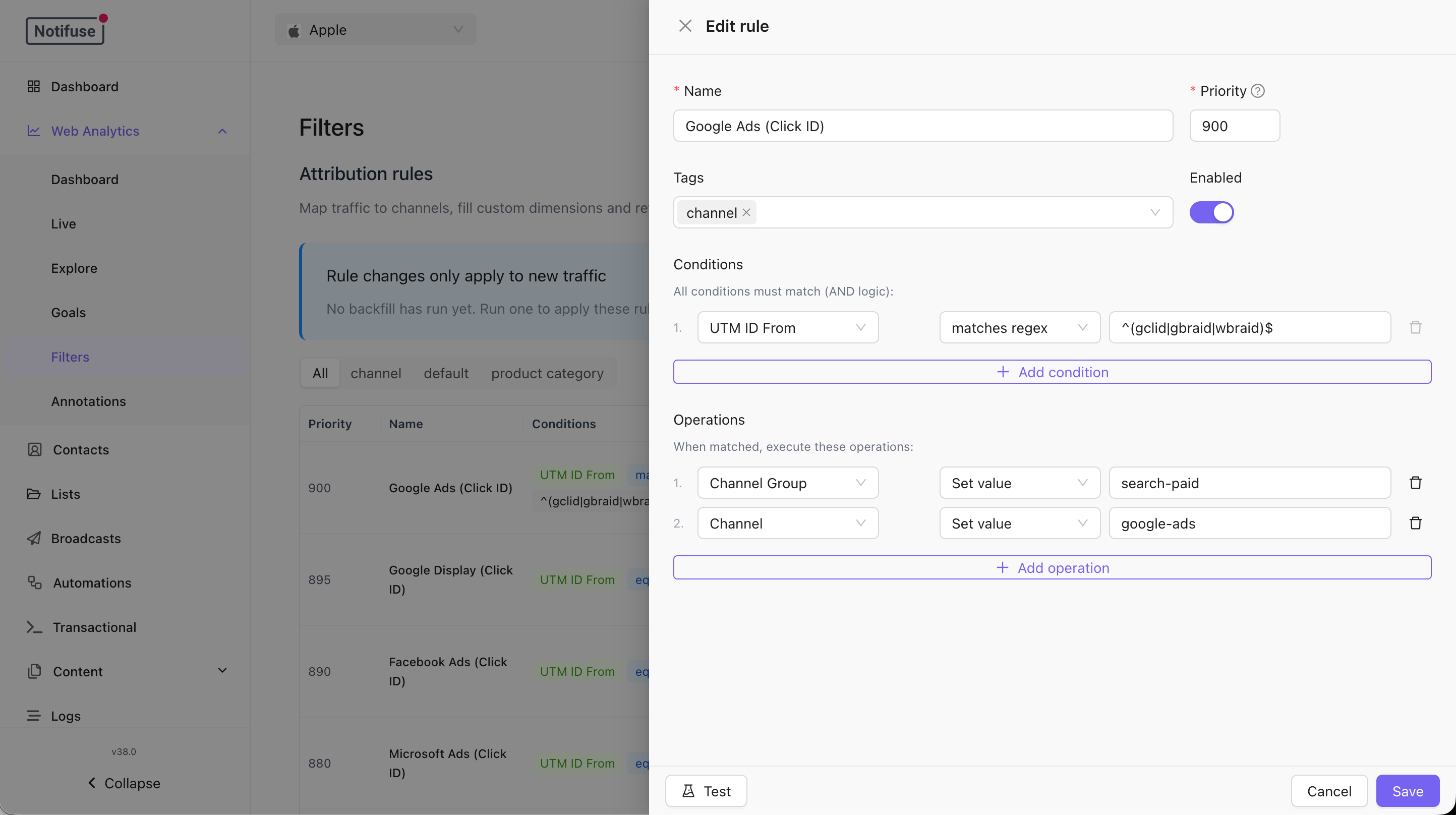 * **Conditions** test any tracked signal: the referrer, referrer domain and referrer path, is-direct, the landing page, domain and path, the current path, every UTM parameter and the ad click ID, plus device, browser, browser type, OS, user agent, connection type, language and timezone.
* **Operators** are `equals`, `not equals`, `contains`, `not contains`, `is empty`, `is not empty` and `regex`.
* **Operations** then `set` a value, `set` it only as a *default* where nothing else has written one, or `unset` it.
* **Targets** are Channel, Channel Group, any of the five UTM fields, Referrer Domain, Is Direct, and `custom_1` through `custom_10`.
Writing a custom dimension from a rule is how you classify traffic you could not tag at the source — a partner's referrer becomes a partner name, say, without asking them to add parameters.
## Ad Click IDs
The tracker recognises thirteen ad click ids on the landing URL: `gclid`, `wbraid`
and `gbraid` (Google Ads), `dclid` (Google Display), `fbclid` (Meta), `msclkid`
(Microsoft), `ttclid` (TikTok), `li_fat_id` (LinkedIn), `twclid` (X), `epik`
(Pinterest), `ScCid` (Snapchat), `rdt_cid` (Reddit) and `qclid` (Quora).
The first one present lands in `utm_id`, and the parameter it came from in
`utm_id_from` — so a paid click is attributable even when the campaign forgot its
UTMs. "First" means first in that list, not first in the URL, so a link carrying
both `gclid` and `fbclid` is attributed to Google.
Matching ignores case: `?sccid=`, `?ScCid=` and `?SCCID=` are all recognised, and
`utm_id_from` always records the canonical spelling above — which is what the
built-in rules match on.
To capture a click id of your own **in addition** to those thirteen, set
`extraAdClickIds: ['myclid']` in `NotifuseAnalyticsConfig`. `adClickIds` also
exists but **replaces** the list outright, and `adClickIds: []` captures none —
use it only when that is what you want. A rule matching on `utm_id_from` only
ever fires for a parameter the tracker was told to capture.
## Changing Rules Later
Rules are applied when a visit is recorded, so editing them changes what happens next, not what already happened. To apply them to existing traffic, run a **backfill** from the Filters tab.
A backfill rewrites the attribution columns on historical **session and goal** rows — which is what updates "revenue by channel" for past traffic. It never adds, removes or re-times traffic, and pageview rows are not touched at all.
A backfill **clears** Channel and Channel Group on any row its rules do not write.
Those two exist only because a rule said so, so "no rule matches" means empty.
Custom dimensions are left alone, because your tracker can set them without any
rule being involved. A rule that targets one still rewrites the rows it matches,
and an `unset_value` rule still clears them — but a row no rule matches keeps
whatever your site sent. One consequence worth knowing: a custom value written by
a rule survives that rule's deletion, since nothing can tell it from a
tracker-supplied one afterwards. Clear it with a temporary `unset_value` rule.
One backfill runs at a time, per workspace. Cancelling stops it where it is; the partitions already rewritten keep their new values, so a cancelled run leaves your data in a mixed state until you run it again.
## Where the Traffic Comes From
Broadcasts add UTM parameters to their links — see [Broadcast Campaigns → UTM Tracking](/features/broadcast-campaigns#utm-tracking). Those are exactly what the seeded Email rule looks for, so campaign traffic classifies itself with no extra work.
## Notes
* Attribution is resolved per session, from the landing page. A visitor who arrives from a search and later clicks one of your emails starts a new session with its own attribution once the first has ended.
* Goals start from their session's attribution, then re-run the rules with the goal's *own* page path. A goal matches its session unless one of your rules tests the current path.
* The rule set is versioned by a hash the server recomputes on every save. The console compares it against the version of the last completed backfill to warn you when your history was attributed under a different rule set. A backfill rewrites every historical row, not just the stale ones.
* [API Reference](/api-reference)
* **Conditions** test any tracked signal: the referrer, referrer domain and referrer path, is-direct, the landing page, domain and path, the current path, every UTM parameter and the ad click ID, plus device, browser, browser type, OS, user agent, connection type, language and timezone.
* **Operators** are `equals`, `not equals`, `contains`, `not contains`, `is empty`, `is not empty` and `regex`.
* **Operations** then `set` a value, `set` it only as a *default* where nothing else has written one, or `unset` it.
* **Targets** are Channel, Channel Group, any of the five UTM fields, Referrer Domain, Is Direct, and `custom_1` through `custom_10`.
Writing a custom dimension from a rule is how you classify traffic you could not tag at the source — a partner's referrer becomes a partner name, say, without asking them to add parameters.
## Ad Click IDs
The tracker recognises thirteen ad click ids on the landing URL: `gclid`, `wbraid`
and `gbraid` (Google Ads), `dclid` (Google Display), `fbclid` (Meta), `msclkid`
(Microsoft), `ttclid` (TikTok), `li_fat_id` (LinkedIn), `twclid` (X), `epik`
(Pinterest), `ScCid` (Snapchat), `rdt_cid` (Reddit) and `qclid` (Quora).
The first one present lands in `utm_id`, and the parameter it came from in
`utm_id_from` — so a paid click is attributable even when the campaign forgot its
UTMs. "First" means first in that list, not first in the URL, so a link carrying
both `gclid` and `fbclid` is attributed to Google.
Matching ignores case: `?sccid=`, `?ScCid=` and `?SCCID=` are all recognised, and
`utm_id_from` always records the canonical spelling above — which is what the
built-in rules match on.
To capture a click id of your own **in addition** to those thirteen, set
`extraAdClickIds: ['myclid']` in `NotifuseAnalyticsConfig`. `adClickIds` also
exists but **replaces** the list outright, and `adClickIds: []` captures none —
use it only when that is what you want. A rule matching on `utm_id_from` only
ever fires for a parameter the tracker was told to capture.
## Changing Rules Later
Rules are applied when a visit is recorded, so editing them changes what happens next, not what already happened. To apply them to existing traffic, run a **backfill** from the Filters tab.
A backfill rewrites the attribution columns on historical **session and goal** rows — which is what updates "revenue by channel" for past traffic. It never adds, removes or re-times traffic, and pageview rows are not touched at all.
A backfill **clears** Channel and Channel Group on any row its rules do not write.
Those two exist only because a rule said so, so "no rule matches" means empty.
Custom dimensions are left alone, because your tracker can set them without any
rule being involved. A rule that targets one still rewrites the rows it matches,
and an `unset_value` rule still clears them — but a row no rule matches keeps
whatever your site sent. One consequence worth knowing: a custom value written by
a rule survives that rule's deletion, since nothing can tell it from a
tracker-supplied one afterwards. Clear it with a temporary `unset_value` rule.
One backfill runs at a time, per workspace. Cancelling stops it where it is; the partitions already rewritten keep their new values, so a cancelled run leaves your data in a mixed state until you run it again.
## Where the Traffic Comes From
Broadcasts add UTM parameters to their links — see [Broadcast Campaigns → UTM Tracking](/features/broadcast-campaigns#utm-tracking). Those are exactly what the seeded Email rule looks for, so campaign traffic classifies itself with no extra work.
## Notes
* Attribution is resolved per session, from the landing page. A visitor who arrives from a search and later clicks one of your emails starts a new session with its own attribution once the first has ended.
* Goals start from their session's attribution, then re-run the rules with the goal's *own* page path. A goal matches its session unless one of your rules tests the current path.
* The rule set is versioned by a hash the server recomputes on every save. The console compares it against the version of the last completed backfill to warn you when your history was attributed under a different rule set. A backfill rewrites every historical row, not just the stale ones.
* [API Reference](/api-reference)